
Jesús Javier Mateos Hernández-Briz a,* y Óscar Liébana Carrascob
a Ingeniero de Caminos, Canales y Puertos. FCC Construcción.
b Doctor Arquitecto. Universidad Politécnica de Madrid.
resumen
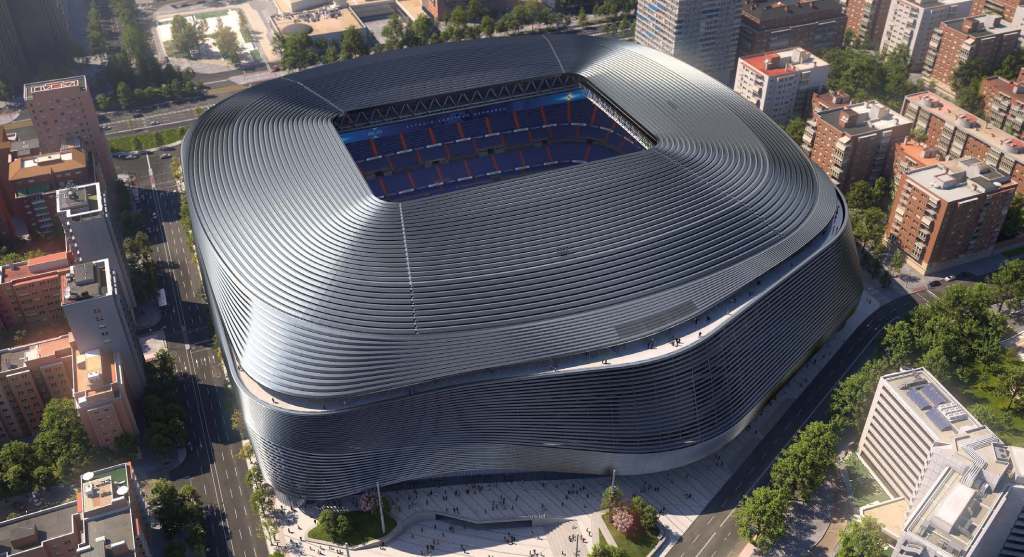
El Real Madrid C.F. ha llevado a cabo una ambiciosa reforma del estadio Santiago Bernabéu, un icono no sólo deportivo sino de la ciudad de Madrid, un edificio de mediados del siglo XX con numerosas reformas y ampliaciones hasta la innovadora propuesta de convertir el estadio en un recinto multiusos, dotándolo de una envolvente completa que proporciona aislamiento ante inclemencias atmosféricas, renovando su
imagen y creando un nuevo estándar de lo que es un estadio multifuncional moderno.
FCC construcción ha sido el encargado de realizar el diseño y ejecución en un modelo de fast-track, con una gran complejidad logística y de ejecución. El proyecto ha supuesto un hito desde el punto de vista estructural, de los procedimientos de ejecución, aplicación de soluciones y materiales innovadores, siendo foco de atención de la ciudad de Madrid durante toda su ejecución.
En este artículo se describe, a partir de la historia del recinto, la dificultad de los trabajos sobre un edificio del siglo pasado a rehabilitar y en pleno uso, hasta el desarrollo de las principales actuaciones arquitectónicas, estructurales, de instalaciones y tecnológicas, con su problemática y soluciones innovadoras para completar una de las actuaciones más complejas desarrolladas en un entorno urbano.
abstract
Real Madrid C.F. has undertaken an ambitious renovation of the Santiago Bernabéu Stadium, an icon not only in sports but also in the city of Madrid. This mid-20th century building has undergone numerous renovations and expansions, culminating in an innovative proposal to transform the stadium into a multi-purpose venue. The stadium now features a complete enclosure that provides protection
against adverse weather conditions, renewing its image and setting a new standard for what a modern multifunctional stadium should be.
FCC Construcción was responsible for the design and execution of the project using a fast-track model, which involved significant logistical and execution complexity. The project has been a milestone from a structural perspective, in terms of execution procedures, and the application of innovative solutions and materials, drawing the attention of the city of Madrid throughout its execution.
This article describes, starting from the history of the venue, the challenges of working on a building from the last century that needed to be rehabilitated while still in use, to the development of the main architectural, structural, installation, and technological interventions, along with their challenges and innovative solutions to complete one of the most complex projects carried out in an urban environment.
©2025 Hormigón y Acero, the journal of the Spanish Association of Structural Engineering (ACHE). Published by Cinter Divulgación Técnica S.L. This is an open-access article distributed under the terms of the Creative Commons (CC BY-NC-ND 4.0) License
Vol. 76 Núm. 307 (2025): Hormigón y Acero /
Monog. Estadio Santiago Bernabéu
DOI: https://doi.org/10.33586/hya.2025.3988


 Digital Transformation in Construction